
Review | Stray - A cat’s adventure in a neon-lit dystopia

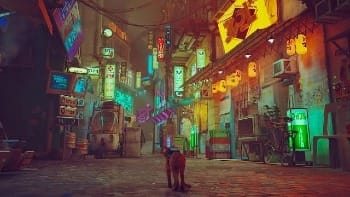
Since its announcement, Stray captured players’ curiosity with an unconventional premise: taking on the role of a lost cat in a futuristic world inhabited solely by robots. What could have seemed like a risky idea proved to be a success, becoming one of the most talked-about indie games of recent years. Compact, accessible, and visually striking, Stray is an adventure that blends mechanical simplicity with a strong emotional core, leaving a lasting impression even after the final credits roll.

A city full of life (or almost)
Stray stands out from the very first minute thanks to its setting. The underground city, inspired by decaying urban spaces and illuminated by vibrant neon lights, is packed with detail and personality. Every alley, hidden corner, and robot you encounter conveys the feeling of a living world—as if you were exploring a place abandoned by humans, yet still filled with memories and history.
The charm of an unlikely protagonist
Controlling a cat might have seemed like a gamble, but it is precisely this detail that makes Stray special. The animations are incredibly faithful and realistic, conveying authenticity in every jump, meow, and curious gesture. The simple acts of scratching carpets, knocking objects off ledges, or rubbing against robots create genuine moments that make the protagonist irresistible and truly unique within the genre.
Simple but effective gameplay
In terms of mechanics, Stray focuses on accessibility. The gameplay is intuitive, easy to grasp, and consistently satisfying. The puzzles, while relatively basic, are well integrated and provide a pleasant sense of progression. The city’s vertical exploration encourages curiosity, rewarding players with secrets and subtle interactions. More tense moments—such as chases or stealth sections against drones—add variety without disrupting the game’s pacing.
A subtle and emotional narrative
Stray’s story does not follow a conventional structure, instead unfolding through exploration, conversations with robots, and the memories recovered by the small drone B-12. This approach results in an intimate and emotional experience, even if some key moments could have been delivered with greater impact. Still, themes of loneliness, friendship, and hope are conveyed with sensitivity, with the relationship between the cat and B-12 offering touching moments that linger in memory.
A beautiful and decaying world
Visually, Stray impresses with detailed environments and a strong use of light and color that reinforces the game’s unique atmosphere. The aesthetic blends the charm of the unknown with the melancholy of an abandoned world, creating a striking visual experience. Although relatively short—around six to eight hours—the game remains compact and well balanced, never overstaying its welcome.
Conclusion
Stray is a brief but delightful adventure. Its extraordinary setting, the charisma of its protagonist, and the effective simplicity of its mechanics make it a memorable experience. It may not be a perfect game and could have explored certain narrative elements more deeply, but overall it delivers something unique and captivating that is well worth experiencing.
